Dental Hygiene
The Order Your Oral Routine Should Actually Follow
I did the same three things every night for twenty years in the wrong order, and the last one was undoing part of the first. Every fix here is free.
By Sarah · August 8, 2026 · 10 min read

Key takeaways
- Clean between your teeth first, then brush. The sequence changes what the same two minutes achieve.
- Do not rinse with water straight after brushing — you wash away the fluoride that was about to do the work.
- Two minutes is longer than it feels. Most people stop around eighty seconds and miss the same quadrant every time.
- The night routine matters more than the morning one, because of what happens to saliva overnight.
- Electric versus manual matters far less than technique, pressure and how long you actually spend.
- Three steps you do every night beat six you abandon by Thursday.
I did the same three things every night for twenty years in the wrong order, and the thing I did last was washing away the most useful part of what came before it. Nobody had ever told me that sequence changes what the same two minutes achieve, or that my final step was quietly undoing my first one.
That is the whole subject of this article. Everything in it is free, none of it takes any extra time, and the fixes are mostly a matter of rearranging things you already do.
The correct order, and why sequence changes the result
The order that most hygienists I have asked suggest is:
- Clean between the teeth first — floss, interdental brushes, or a water flosser.
- Brush second, for two full minutes, with fluoride toothpaste.
- Spit. Do not rinse.
The reasoning is straightforward once you hear it. Cleaning between the teeth first loosens and dislodges what is trapped in the spaces a brush cannot reach. Brushing afterwards then carries that material away rather than leaving it sitting where it was disturbed.
There is a second, less obvious benefit. Those between-tooth surfaces make up roughly a third of the total surface area of each tooth, and they have just been cleared. Brushing second means the fluoride in your toothpaste reaches surfaces that were blocked a minute earlier. Do it the other way around and the fluoride never gets there.
It is genuinely the same three activities. Only the order changes, and it changes what you get out of them.
The rinsing mistake almost everyone makes
This is the single easiest improvement available to most people, and I made the mistake for two decades.
Fluoride toothpaste works partly while you are brushing and substantially afterwards, from the thin residue left on the teeth. That residue continues to make the enamel surface more resistant for a while after you have finished. When you rinse vigorously with water, you wash that residue away and end the useful part early.
So: spit out the excess and stop there. Do not rinse with water, and do not immediately follow with a mouthwash, because most rinses contain far less fluoride than toothpaste and will dilute what you just applied.
If you want to use a fluoride mouthwash, use it at a different time of day entirely — after lunch, say — so it is doing its own job rather than washing away another one.
It feels wrong for about a week. The film on your teeth is unfamiliar and mildly unpleasant if you are used to rinsing. Then you stop noticing, and it is free.
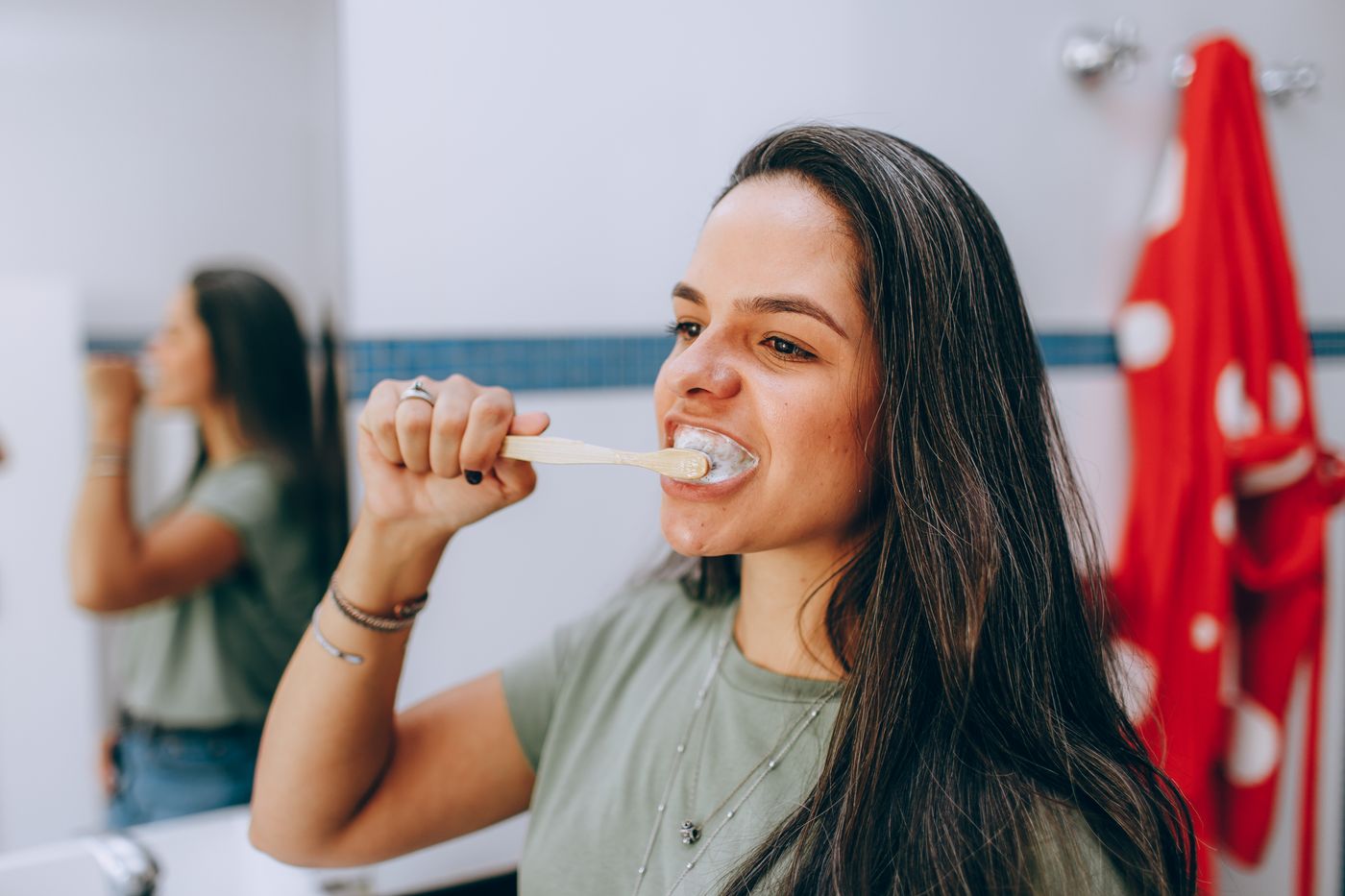
Two minutes, and where the missing forty seconds go
Two minutes is considerably longer than it feels. Studies of brushing behaviour consistently find people report brushing for two minutes and actually brush for somewhere between forty-five and ninety seconds.
The practical fix is to divide the mouth into four quadrants and give each thirty seconds: upper right, upper left, lower left, lower right. Within each, cover the outer surfaces, the inner surfaces and the biting surfaces.
The missing time is almost always in the same place. Most right-handed people shortchange the inner surfaces of the lower front teeth and the outer surfaces of the upper right molars, because both are awkward angles. If you are left-handed the mirror image applies. It is worth deliberately starting in the quadrant you usually rush, because whatever you do first gets the most attention.
On pressure
Harder is not better and is actively worse. Plaque is soft; it needs disturbing, not scrubbing. Excessive pressure wears enamel and contributes to gum recession over years. If the bristles on your brush splay outwards within a month, you are pressing too hard.
Why brushing straight after coffee is worth avoiding
Acidic food and drink briefly soften the enamel surface. Brushing during that window means scrubbing at enamel that is temporarily more vulnerable.
The straightforward answer is to wait about thirty minutes after anything acidic — coffee, juice, wine, citrus, cola — before brushing, and to rinse with plain water in the meantime.
For most people the neatest solution is simply to brush before breakfast rather than after. You clean the mouth after a night of low saliva, you apply fluoride before the acid arrives rather than after, and you sidestep the timing question entirely.
Why the night routine matters more than the morning one
If you are only going to do one of the two properly, make it the evening one.
During the day, saliva is constantly buffering acid, clearing debris and carrying minerals back to the tooth surface. At night, saliva production falls a long way. That leaves roughly eight hours in which the mouth is drier, less able to neutralise acid, and less able to clear anything you left behind.
So whatever you go to bed with stays there, in a less protected environment, for a third of the day. The night routine is the one that determines what the mouth spends its most vulnerable hours dealing with.
That is also why the no-rinse rule matters most at night, and why anything eaten after brushing undoes the point of having brushed.

A supporting habit, not a substitute. ProDentim is a daily oral probiotic supplement meant to sit alongside brushing, cleaning between your teeth and regular dental visits — never in place of them. Learn More About ProDentim (Affiliate link)
Electric versus manual: the honest answer
An electric brush is easier to use well. That is the honest summary and most of the difference.
It removes the technique problem — you hold it against each tooth and let it work rather than needing a good scrubbing motion. Most have a two-minute timer, which addresses the duration problem. Many have a pressure sensor, which addresses the pressing-too-hard problem. Those three things together are why people who switch often see an improvement.
But a manual brush used with good technique, for the full two minutes, with light pressure, does the job. Someone who uses a manual brush properly is in a better position than someone who uses an electric brush for forty seconds while looking at their phone.
If you are choosing: an electric brush is a reasonable purchase and the cheap ones are fine. It is not a requirement, and it is not the most important variable. Technique, time and pressure matter more than the handle.
Cutting six steps down to three
At one point my routine had six steps in it and I was doing all six about twice a week, which is worth less than three steps done every night.
What I kept:
- Cleaning between the teeth — the step with the most benefit and the one most often skipped.
- Two minutes of brushing with fluoride toothpaste, gently.
- Spit, do not rinse.
What I dropped, and why:
- The antiseptic rinse, which was undoing the fluoride and drying my mouth out.
- Whitening toothpaste on rotation, which was abrasive and aimed at the wrong problem.
- A second brushing after dinner, which mostly meant brushing straight after acidic food.
A routine you complete on a tired Tuesday is worth more than an ideal one you manage on Sundays. That is the least glamorous sentence in this article and probably the most useful one.
Floss, interdental brushes, or a water flosser?
The step with the most benefit is also the one people find fiddliest, so it is worth saying that floss is not the only way to do it.
Interdental brushes
Small tapered brushes that go between the teeth. For anyone whose gaps are large enough to take one, most hygienists I have spoken to prefer them — they are easier to use well, they clean a larger proportion of the surface, and people stick with them because they take less dexterity. The catch is sizing. Too small does nothing and too large is uncomfortable, and you may well need two or three sizes for different parts of your mouth. This is a good thing to have someone size for you once rather than guess at.
Floss
Still the answer where teeth are tight together and a brush will not pass. The technique that matters: curve it into a C around the side of each tooth and slide it gently under the gum line, rather than snapping it straight down and pulling it out. The point is the side surface of the tooth, not the gap itself.
Water flossers
Genuinely useful for people with bridges, implants or braces, and much better than nothing for anyone who will not floss. They flush the area rather than wiping the surface, so most guidance treats them as a complement rather than a straight replacement. If the realistic choice is a water flosser or nothing at all, the water flosser wins easily.
Whichever you use, once a day is the target and the evening is the time. Doing it well three times a week beats doing it badly every day, but doing it well every day is the thing that actually changes what a hygienist sees.
Worth asking your hygienist
I am not a dentist or a hygienist, and this is general information rather than advice for your mouth specifically. A hygienist can see things you cannot, and these are good questions for the five minutes at the end of a cleaning:
- Am I missing anywhere in particular? They can usually tell immediately.
- Am I pressing too hard? There are signs they can see and you cannot.
- Should I be using floss, interdental brushes, or something else? This depends on the gaps between your teeth.
- Is there any sign I grind at night?
Bleeding that continues beyond a fortnight of good cleaning, a tooth that has become sensitive or loose, or persistent pain are all reasons to make an appointment rather than adjust a routine.
Where this went for me
Fixing the order was free and it helped, and it was not enough on its own. Once the routine was as good as rearranging things could make it, the only remaining question was what else was going on in my mouth — which is a longer story, and the one that actually changed things.
Frequently asked questions
- Should you floss before or after brushing?
- Before. Cleaning between the teeth first loosens what is trapped there so the brushing that follows carries it away, and it clears those surfaces so the fluoride in your toothpaste can actually reach them.
- Should you rinse with water after brushing?
- No. Rinsing washes away the fluoride residue that keeps working after you have finished. Spit out the excess and leave it. This is the easiest change on the list and it costs nothing.
- Is an electric toothbrush actually better?
- It is easier to use well — it removes the technique problem, usually includes a timer, and often has a pressure sensor. A manual brush used properly for the full two minutes does the job. Technique, duration and pressure matter more than which handle you hold.
- Is it better to brush before or after breakfast?
- Before works well for most people. You clean after a night of reduced saliva, you apply fluoride before acid arrives rather than after it, and you avoid brushing during the window when acidic food or drink has briefly softened the enamel surface.

Written by
Sarah
Wellness writer — founder of Sarah Wellness Corner
Sarah is a pen name. She is a wellness content creator writing from a consumer's perspective, not a clinician's — she is not a dentist, dental hygienist, doctor or medical professional of any kind, and holds no clinical qualification. Her articles are personal experience and general education, written after reading widely and changing her own habits over several years. They are not medical advice and are not a substitute for a consultation with a qualified dental professional. Identifying details in the personal stories on this site have been changed; the experiences are real, the names and specifics are not.
Join the Sarah Wellness Corner Community
Receive practical oral care tips, healthy habits, educational articles, and wellness inspiration.
Related articles

10 Daily Habits That Help Keep Your Smile Healthy
Healthy teeth are rarely the result of one big change. They are the result of ten small things repeated on ordinary days. Here is what dental professionals talk about most often — and how to make each habit realistic.

Why Bad Breath Comes Back, Even When You Brush Twice A Day
Breath that is fine at nine and back by two is a different problem from morning breath, and it usually is not a brushing problem. Here is where the odour actually comes from and how to check your own honestly.
Electric vs Manual Toothbrush: Which One Is Right for You?
The honest answer is that a well-used manual brush beats a badly used electric one. But the research does show a real average difference. Here is how to work out which side of that average you are on.
The Drinks And Foods That Stain Teeth, And What To Do About Each
Nobody is giving up coffee, and they should not have to. Every item on this list has a fix — and part of what people try to scrub away is not stain at all.
Natural Oral Care That Actually Held Up
I tried a great many natural oral-care ideas. Three of them are still part of my week. Here is why those three and not the others.
The One Natural Thing That Stuck
It is not oil pulling. It is not a rinse. It is a three-second sequencing change, and it is the only thing I have done every day without fail.